


Lip (20X)
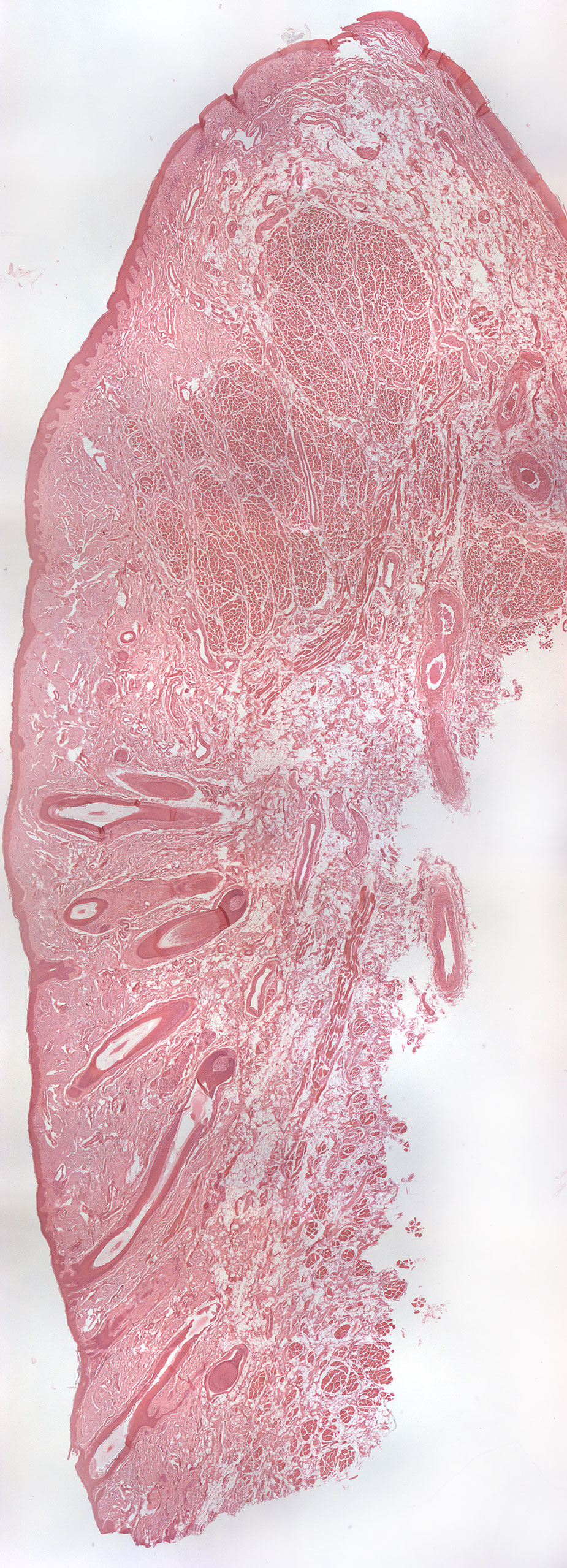
This is a saggital section through a lip. Macroscopically, the lips are have 3 distinct zones. The outide of the lip is scovered by the skin, a red part (depending on the persons origin) called the vermilion and the mucosa
As stated above, most of the outer surface is covered by the skin (dermis and epidermis). On its surface, you'll find a thin, keratinized layer of epithelial cells (no nuclei to be seen).
The vermillion has its red color not beacuse of pigment but is a result of the interplay between the structure of the epithelium and the underlying vascular supply. The vermilion can be destinguished histologically by the absence of skin appendages: It lacks hair follicles, sebaceous glands, and sweat glands, which is a key difference from typical facial skin. There is also a high concentration of long, slender rete pegs that extend into the dermis, maximizing the surface area and bringing blood vessels closer to the surface.
On the inside, the lip is covered by mucosa.
Below the epithelium, you'll find connective tissue, glandular tissue and the orbicularis oris muscle.